
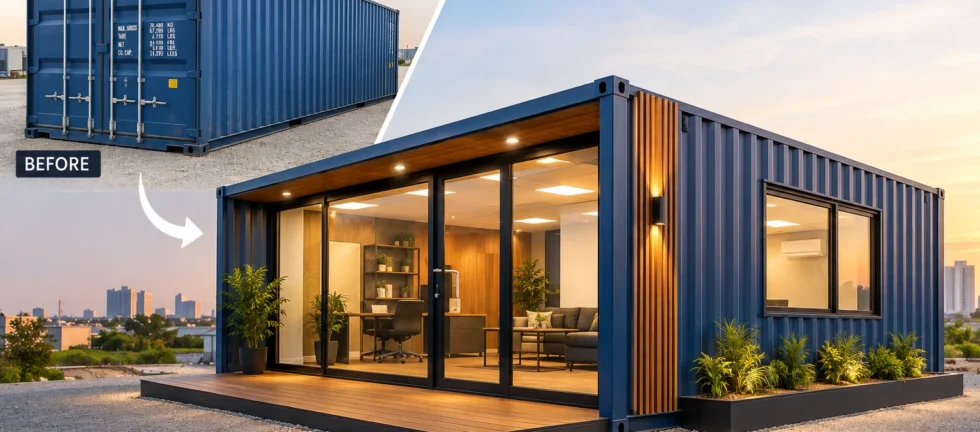
Somewhere in Dubai right now, a shipping container that spent the last decade hauling cargo across the Arabian Sea is being turned into a site office with air conditioning, a proper desk, and a coffee machine. That’s not a novelty story anymore it’s just how a huge amount of temporary and semi-permanent building gets done in the UAE these days.
But “container conversion” is one of those phrases that sounds simple until you’re the one paying for it. Is it just cutting a window into a steel box? Does it need approvals? How long does it actually take, and why do two quotes for what looks like the same unit sometimes differ by tens of thousands of dirhams?
This guide walks through the real process from the first conversation to the truck pulling up at your site so you know exactly what to expect and what questions to ask before you commit.
What Container Conversion Actually Means
Strip it back to basics: a shipping container is a welded steel box, built to survive months at sea, stacked six-high on a vessel deck, and dropped, dragged, and forklifted through a dozen ports without failing structurally. That toughness is exactly why it makes such a good starting point for a building, you’re not constructing from nothing, you’re adapting something already engineered to take a beating.
Conversion is the process of turning that cargo box into a usable space cutting in doors and windows, reinforcing the frame where steel has been removed, running electrical and plumbing lines, insulating the walls and roof, and finishing the interior so it actually feels like somewhere you’d want to work or live, not a warehouse shelf.
The part people underestimate is the structural side. A shipping container’s strength comes from its corrugated steel walls and closed frame cut a large opening into that wall without reinforcing around it, and you’ve weakened the very thing that made it strong in the first place. This is precisely why container conversion is an engineering job as much as a design one, and why it should never be treated as a straightforward welding task handed to whoever’s cheapest.
Before Anything Gets Cut: The Planning Conversation
Every conversion that goes smoothly starts with the same thing, a proper conversation before a single tool touches the container. Skip this step, or rush it, and it tends to show up later as a change order, a delay, or a unit that technically works but doesn’t quite fit how you actually operate.
A good planning discussion usually covers:
- What the space is actually for: office, accommodation, retail kiosk, guard room, clinic, workshop, or storage
- How many people will use it day to day, since that drives layout, ventilation, and exits
- Whether one container is enough, or several need to be joined into a larger footprint
- What the delivery site looks like: ground condition, access road width, and room for a crane to lift and place the unit
- Power, water, drainage, and internet needs
- Budget, since this shapes container size, condition, and finish level from the outset
- Any UAE building or safety regulations that apply to the intended use
None of this is red tape for its own sake — every one of these answers changes a real decision downstream, from which container size gets picked to how the electrical layout is drawn.
The Container Conversion Process, Stage by Stage
Step 1: Requirement Assessment
This is where the brief gets locked down properly, what the unit will be used for, the timeline you’re working against, and any specific must-haves like a pantry, a washroom, or a particular workstation layout. Everything that follows is built on the answers gathered here, so it’s worth spending real time on this stage rather than rushing to the fun part.
Step 2: Choosing the Right Container
Not every job needs the same box. 20ft units suit compact offices, guard rooms, and single-person setups; 40ft units give you room for a small team or a multi-zone layout; high-cube versions add extra ceiling height that makes a real difference once insulation and ceiling fittings are in place.
Then there’s new versus used. A brand-new container costs more but arrives dent-free with zero prior wear. A used container costs noticeably less and, once properly inspected for rust, floor damage, and frame integrity, performs just as well structurally for most conversion projects it’s often the smarter budget choice rather than a compromise.
Step 3: Design and Layout Planning
This is where the project stops being an idea and starts becoming a drawing. The layout gets mapped out, where doors and windows go, how the workspace flows, where equipment sits, and how people actually move through the unit day to day. Time spent here pays for itself later: a layout that’s thought through properly avoids wasted floor space and awkward daily friction once the unit is in use.
Step 4: Structural Modification
Once the design is signed off, the fabrication team gets to work cutting the openings for doors and windows, then reinforcing the surrounding steel to make up for what’s been removed. This stage genuinely needs experienced welders and fabricators; get the reinforcement wrong here and the unit can develop structural issues long after it looks finished, which is a far more expensive problem to fix retroactively than to get right the first time.
Step 5: Insulation and MEP Fit-Out
Bare steel and Dubai heat are not friends. Proper insulation usually rockwool, PU foam, or PIR panels lining the walls and roof is what separates a container that’s genuinely comfortable to work in from one that turns into an oven by mid-morning. Alongside insulation, this is when electrical wiring, lighting, AC ducting, and any plumbing get run through the structure, ideally concealed rather than bolted on as an afterthought.
Step 6: Interior Finishing
Flooring, wall panels, ceiling finish, fixtures, and furniture go in at this stage the difference between a basic, functional fit-out and a premium finish comes down almost entirely to the choices made here. This is also where branding touches, like painted exteriors or company signage, typically get applied.
Step 7: Quality Check, Delivery, and Installation
Before anything leaves the yard, a finished unit should go through a proper quality check doors and windows sealing correctly, electrical points tested, no gaps in the insulation, paintwork finished cleanly. Then it’s a matter of transport and crane placement on-site, which needs its own bit of planning: access road width, ground bearing capacity, and any permits the delivery route requires.
What Actually Drives the Cost and Timeline
This is the section most buyers wish someone had walked them through before they started comparing quotes, because “container conversion” covers everything from a bare-bones storage box to a fully fitted, air-conditioned office with a washroom and the price gap between those two is enormous even though both technically qualify as “a converted container.”
| Factor | Why It Moves the Price |
| Container size & quantity | A single 20ft unit vs. several 40ft units joined together changes both steel and labor cost significantly |
| New vs. used condition | New units cost more upfront but need no rust or floor repair |
| Design complexity | Multiple rooms, custom layouts, and joined units take more engineering time than a single open-plan box |
| Number of openings | Each extra door or window means more cutting, more reinforcement, more sealing |
| Structural reinforcement | Larger or more numerous openings need proportionally more steel reinforcement |
| Electrical load & plumbing | A washroom and full power distribution cost more than basic lighting and sockets |
| HVAC sizing | Bigger units or higher occupancy need larger AC capacity |
| Interior finish level | Basic paint-and-panel finish vs. premium flooring, cabinetry, and fixtures |
| Site access & crane needs | Tight access roads or difficult ground conditions add to installation cost |
| Transport distance | Delivery further from the fabrication yard adds to logistics cost |
The practical takeaway: when you’re comparing two quotes for “the same” container conversion, check that both suppliers are actually pricing the same specification. A shell with basic lighting and a fully fitted unit with AC, plumbing, and premium interior finish are not the same purchase, even when the external dimensions match exactly.
What Container Conversions Are Actually Used For in Dubai
The range of use cases has expanded well beyond the classic “site office” image most people still picture. Across the UAE, converted containers now regularly show up as:
- Site offices and project management cabins on active construction sites
- Guard rooms and security checkpoints at gated developments and industrial yards
- Retail kiosks, coffee counters, and pop-up shops in malls, parks, and event spaces
- Mobile clinics and first-aid stations for large labor camps and remote sites
- Mechanical and equipment rooms that need a weatherproof, lockable enclosure
- Storage units for tools, materials, and inventory that need to stay dry and secure
- Standalone or stacked accommodation modules for workforce housing
The common thread across every one of these is the same: a business needed a functional space fast, without the cost and disruption of permanent construction, and a converted container delivered it.
How Container Hub Trading Fits Into This
At Container Hub Trading, container conversion sits alongside our core trading, depot, and offshore container services, which means we’re working with the same steel boxes at every stage, from sourcing the right unit through to handing over a finished, fitted-out space. Based at our depot in Mina Jebel Ali Industrial Area, we work across modular construction, mechanical container rooms, mobile container restaurants, clinical conversions, and straightforward storage units, tailoring each project to the client’s actual brief rather than pushing a one-size-fits-all box.
Having trading, depot, and conversion capability under one roof also means fewer handoffs between suppliers, the same team that sources your container is involved in converting and delivering it, which keeps quality consistent and timelines realistic from the first conversation to installation day.
Final Thoughts
A converted shipping container is only as good as the planning, engineering, and craftsmanship that went into it before it ever reached your site. The businesses that get the best results aren’t the ones who found the cheapest quote they’re the ones who took the planning stage seriously, chose a supplier who could explain the process clearly, and asked the right questions about specification before signing off.
If you’re weighing up a container conversion for your next project in Dubai, start with the brief, not the price tag. Get that right, and everything else the container size, the layout, the finish, the delivery, falls into place a lot more smoothly.